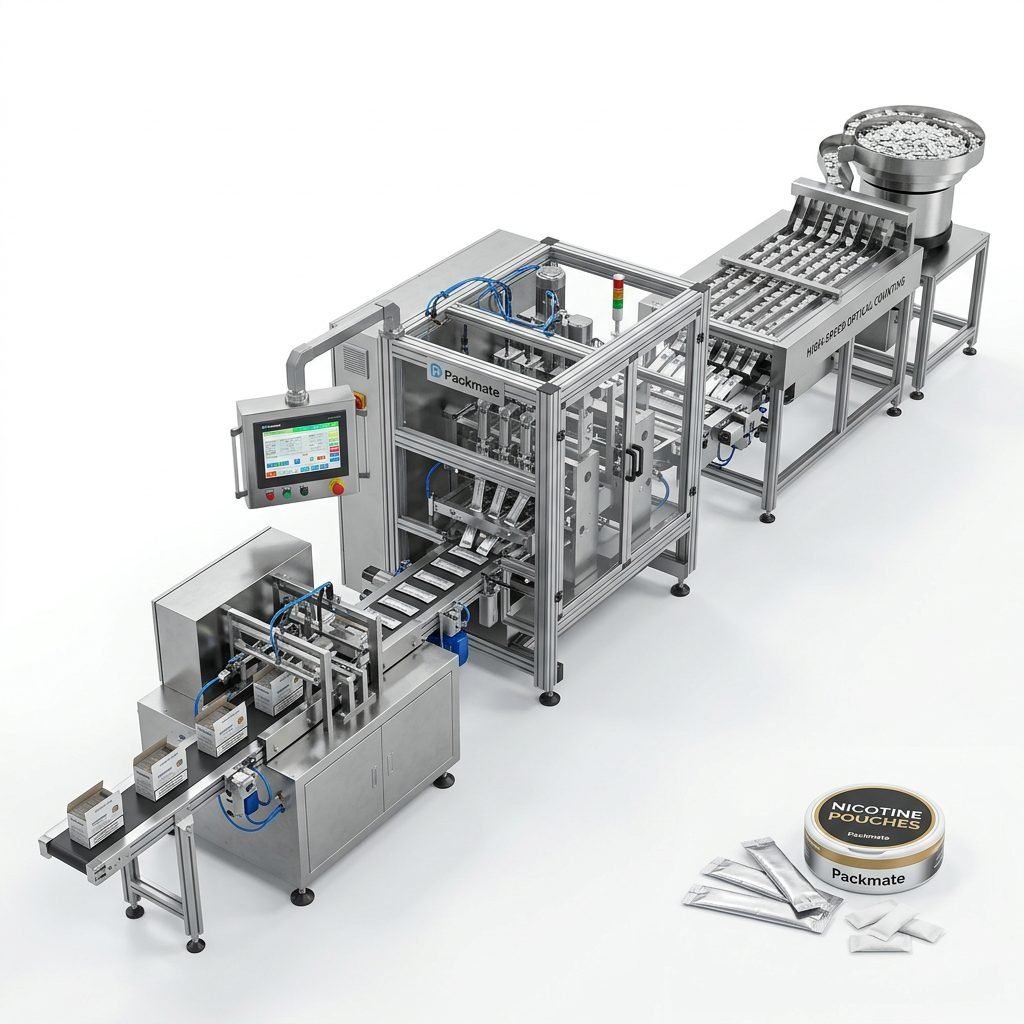
This article walks through a complete nicotine pouch production workflow from raw ingredient handling and mixing through to final packaging and quality control. It focuses on practical steps packaging machinery teams and production engineers follow to deliver consistent, compliant, and scalable nicotine pouch output on automated lines. Expect machine-level considerations, process controls, and packaging integration strategies that align with modern snus and nicotine pouch manufacturing.
⚙️ Raw Material Handling & Pre‑mixing
Raw materials for nicotine pouches typically include filler bases (cellulose, microcrystalline cellulose), nicotine solutions or salts, flavorings, pH adjusters, humectants, and film or pouch substrates. Proper handling begins with verified batch documentation and segregation to prevent cross‑contamination. A typical workflow step includes:
– Receiving and inspection → inventory tagging → transfer to controlled staging areas. Temperature and humidity controls at receiving are critical for hygroscopic ingredients and flavor stability.
For process efficiency, prepare pre‑mix masterbatches where concentrated flavor and nicotine components are dispersed into a carrier before final blending. This reduces dosing variance during high‑speed portioning.
🔎 Key control point
Ensure every incoming lot has certificates and is sampled for moisture and nicotine content. A small deviation at raw material stage can cascade into large weight and potency variances downstream.
Tip: Use automated dosing feeders integrated with the ERP system to log material usage and reduce manual weighing errors.
🔬 Mixing & Masterbatch Preparation
Mixing must achieve a homogenous distribution of nicotine and flavor within the carrier. Typical equipment includes ribbon blenders, high‑shear mixers, or planetary mixers depending on batch size and viscosity of the wet phase. Control strategy:
– Sequence feeding: dry base first, then wet components to prevent localized clumping.
– Temperature monitoring: maintain temperatures that preserve flavor volatiles and nicotine stability.
– Sampling at set intervals for HPLC or rapid in‑house assays to confirm potency.
✅ Mixing performance metrics
Track blend homogeneity (RSD), batch yield, and moisture content. Set in‑process checkpoints before packaging to avoid rework.
Note: Masterbatching flavors can improve flavor consistency across multi‑lane production systems and simplify dosing on high‑speed machines.
⚖️ Portioning & Forming
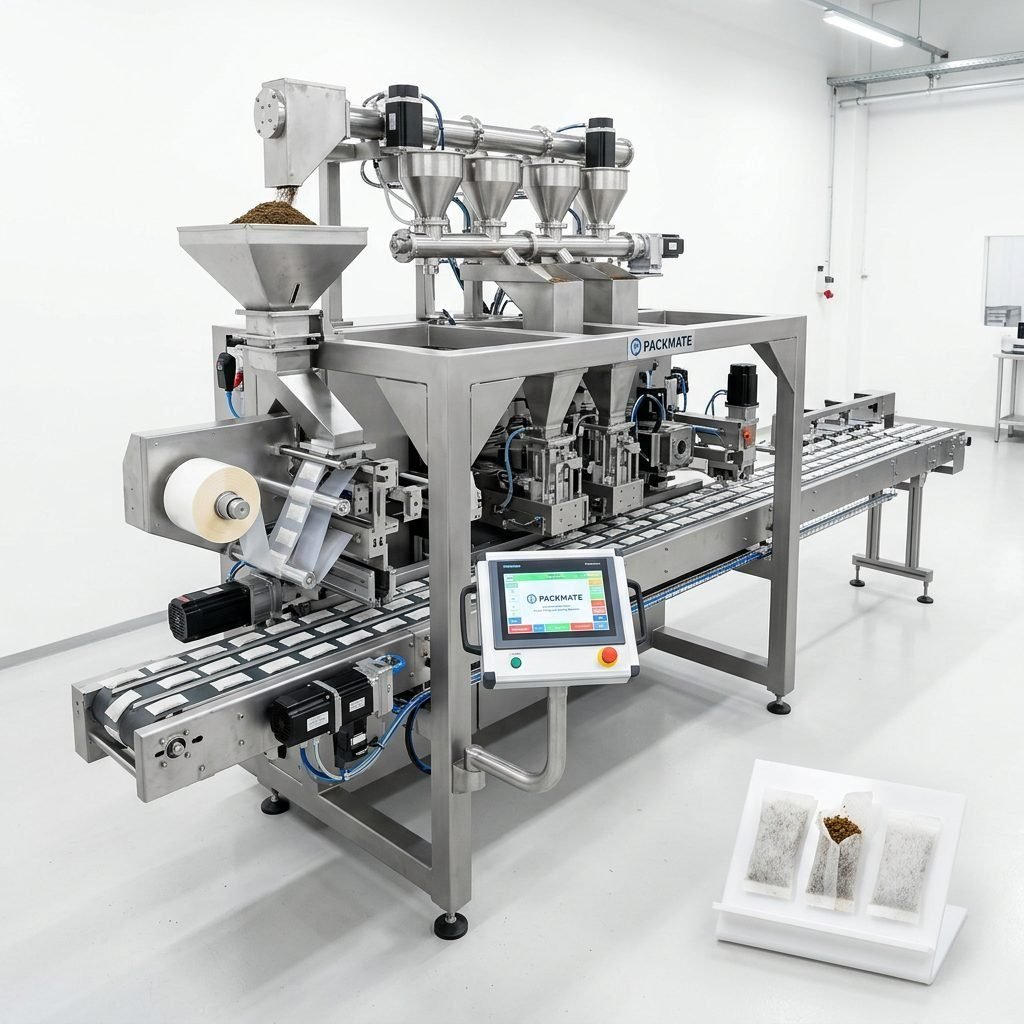
Portioning converts bulk blend to individual pouch or portion sizes. Multi‑lane portioning heads and precision auger or piston fillers are common. Key considerations:
– Electronic load cells or gravimetric feeders for weight accuracy.
– Synchronization between portioning heads and forming stations to avoid misfeeds.
– Frequent checkweigh samples and feedback loops to adjust feed rates automatically.
📌 Critical checks
Set alarm thresholds for underweight or overweight portions. Integrate automatic reject mechanisms to remove nonconforming pouches without stopping the line.
🌬️ Drying & Conditioning
After portioning, some formulations require controlled drying or conditioning to bring moisture to specification and stabilize texture. Drying tunnels, controlled chambers, and dehumidifiers ensure product consistency.
– Monitor water activity (aw) and moisture using inline sensors.
– Keep conditioning times short enough to prevent flavor loss but long enough to meet shelf stability targets.
Important: Over‑drying can increase dust and static, which impairs sealing and handling on high‑speed packaging machines.
🧪 Quality Inspection & Weight Control
Robust QC is essential. Implement statistical process control (SPC) charts, frequent sampling plans, and automated checkweighers. Typical QC elements:
– Weight and moisture checks per shift.
– Potency sampling for nicotine concentration.
– Microbiological control if applicable for water activity.
🧭 Automated feedback
Modern lines use PLC or SCADA integration so checkweigher outputs can adjust filler speeds in real time, reducing scrap and ensuring compliance with label claims.
📦 Primary Pouch/Forming & Filling
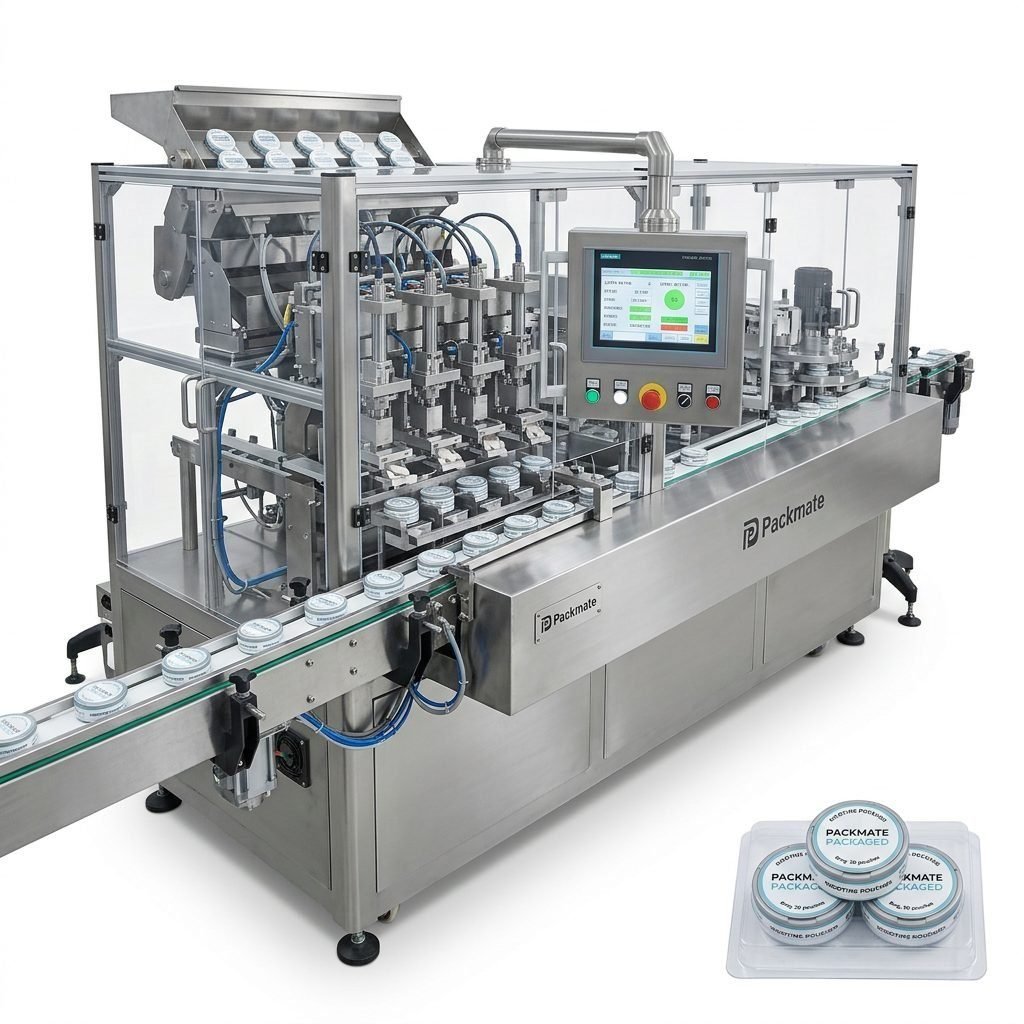
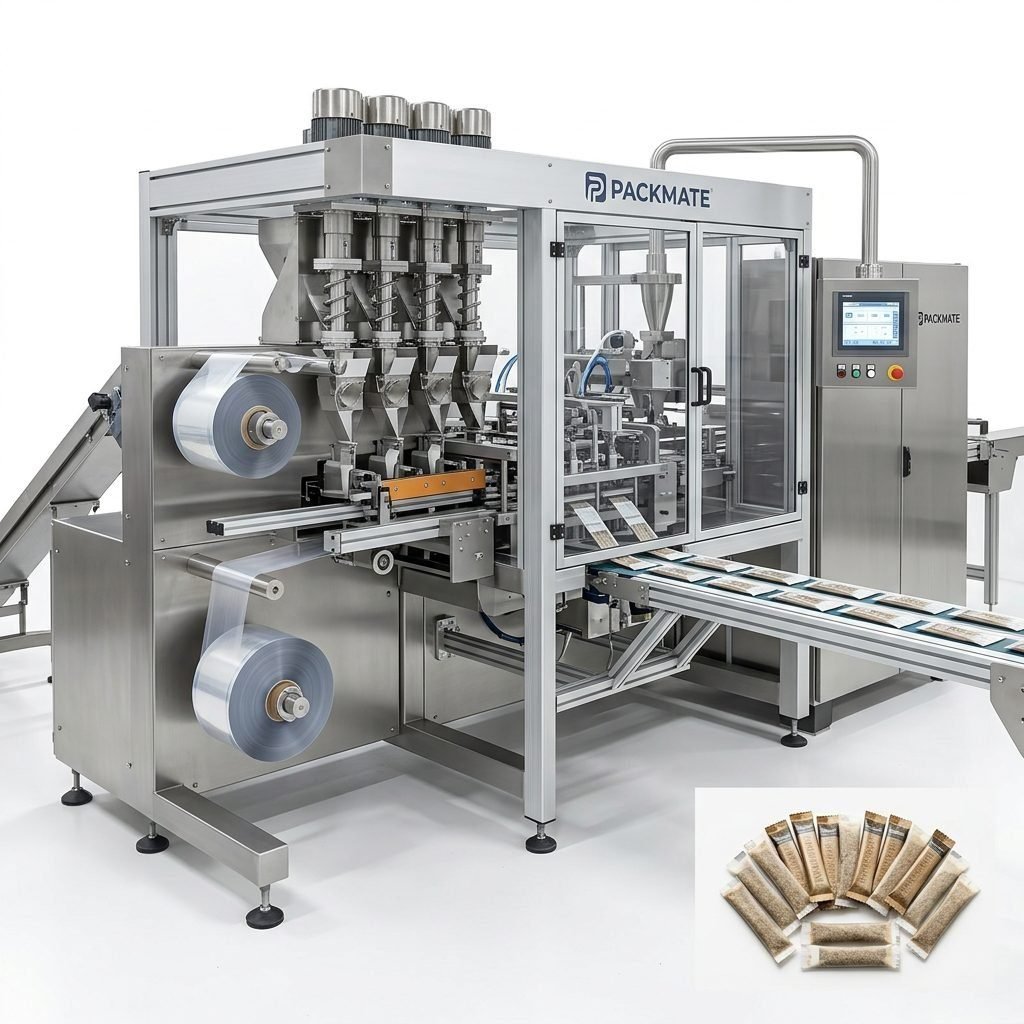
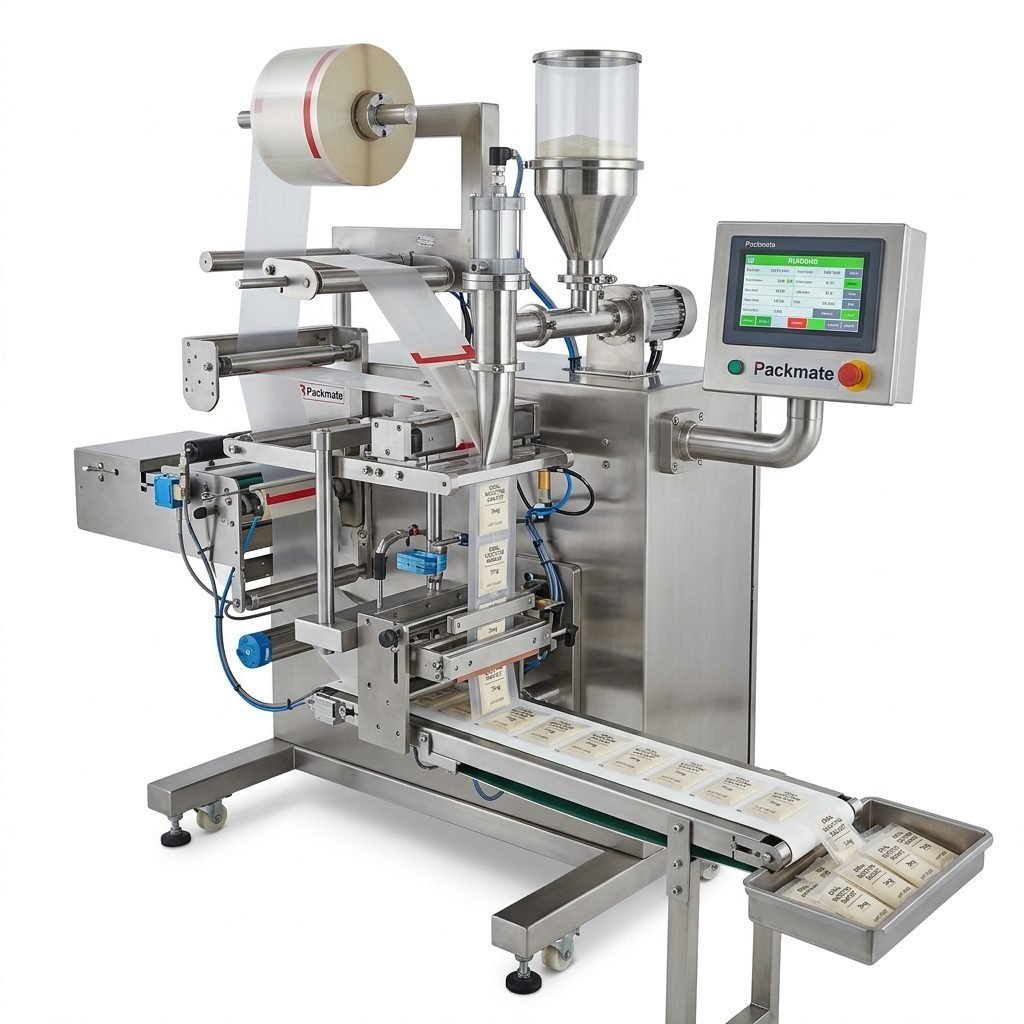
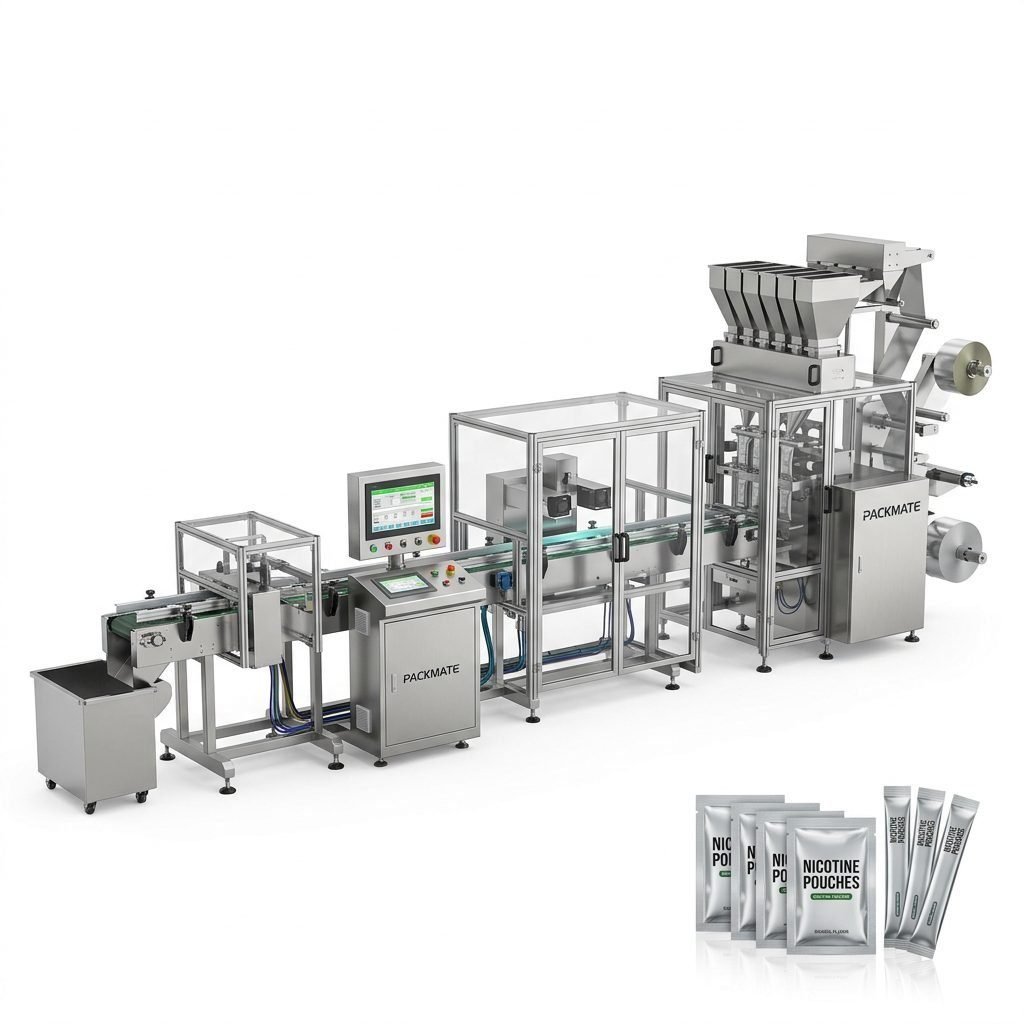
Primary packaging can vary: sachets, stick packs, round pouches or traditional snus cans. Key machine types include form‑fill‑seal (FFS) systems, preformed pouch fillers, and multi‑lane stick pack machines. Consider:
– Material compatibility: evaluate barrier properties for nicotine and flavor retention.
– Speed vs. accuracy tradeoffs: higher lane counts increase throughput but demand precise synchronization.
Packmate offers specialized solutions for snus and nicotine pouch packaging; explore models that support multi‑lane portioning and compact inline filling to meet high output targets:
Snus & Nicotine Packaging Machines.
🔒 Sealing & Cutting
Reliable sealing is non‑negotiable. Use heat seal, ultrasonic, or adhesive methods appropriate to the film. Seal integrity tests (vacuum, dye penetration) must be part of routine checks. For stick packs and sachets, precision cutting ensures consistent portion appearance and package performance.
Seal checklist: film compatibility, seal temperature, dwell time, pressure, and regular die maintenance.
🚚 Secondary Packaging & Cartoning
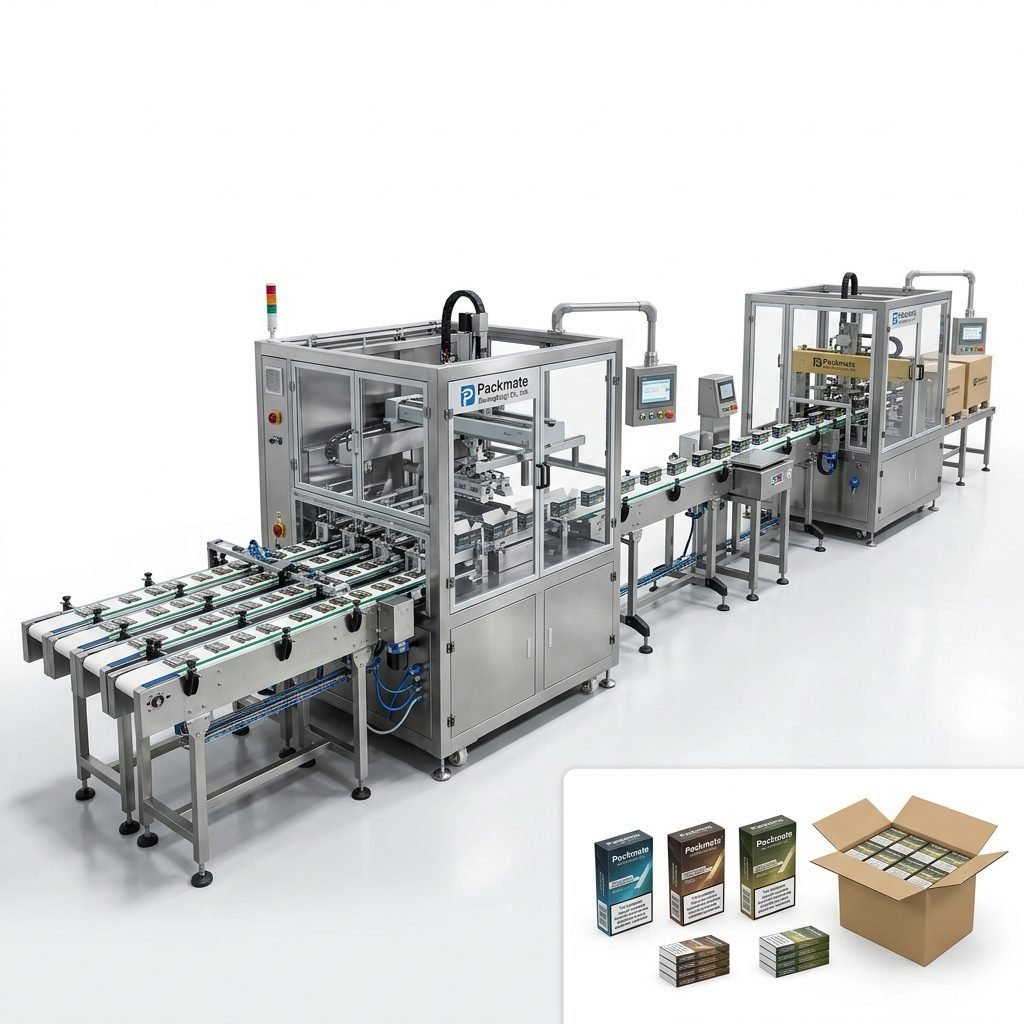
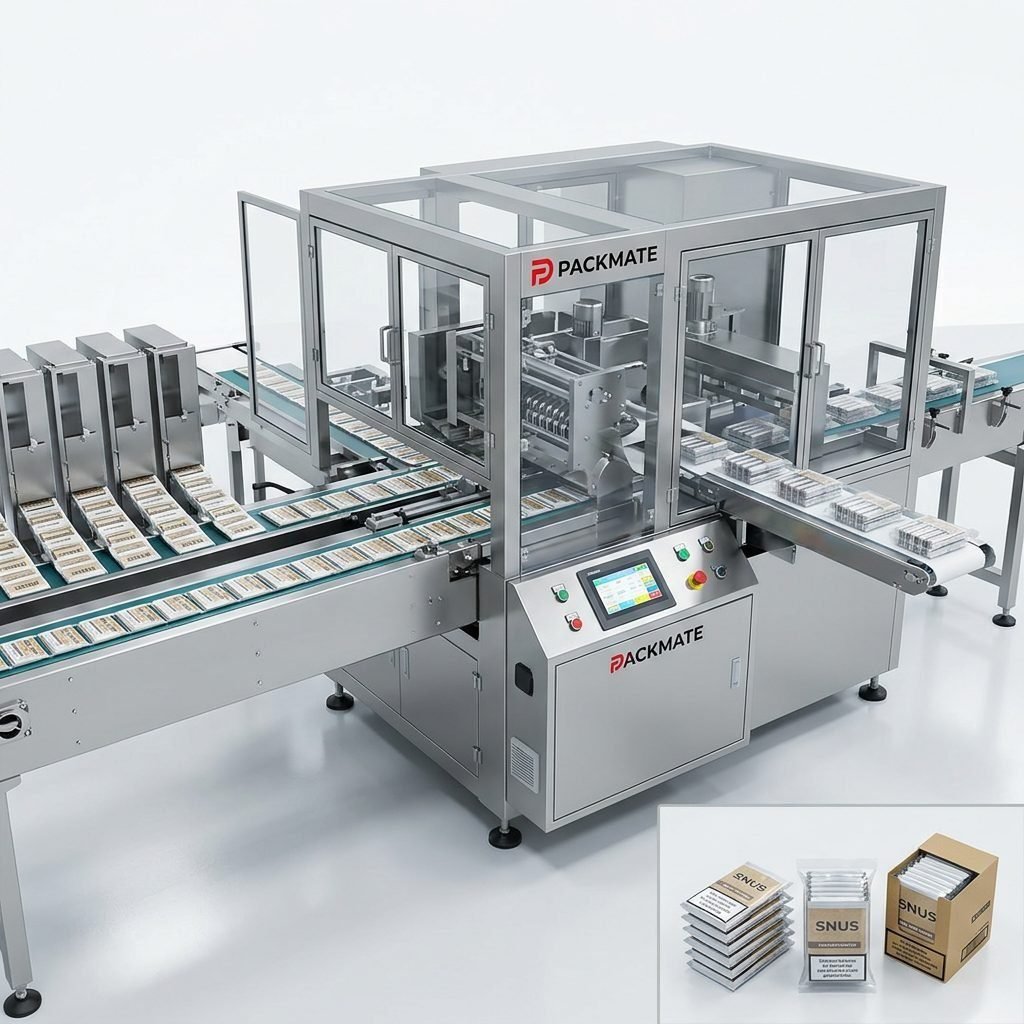
After primary packaging, nicotine pouch products are often grouped into cartons or outer boxes. Secondary packaging machines include cartoners, case packers, and tray formers. Automation here focuses on:
– Orientation and grouping consistency.
– Integration with labeling and coding stations for batch traceability.
– Buffering between primary and secondary lines to cope with speed mismatches.
Browse compatible secondary machines and full production lines for integrated operations:
Filling & Packaging Lines and
Bag & Pouch Packaging Machines.
🏷️ Labeling, Coding & Traceability
Serialization, lot codes, and expiry dates must be applied reliably. Inkjet or laser coders integrated with the line PLC ensure each unit and carton can be traced. Consider:
– Redundant coders for uptime.
– Verification cameras to read and log codes into production records.
– Linking code data to batch QC results for audit readiness.
🔁 In‑line Quality Control & Rejection Handling
Inline inspectors (vision systems, metal detectors, checkweighers) should be placed at strategic points. Rejection paths must be clear and automated to reduce manual intervention. Typical pattern:
– Primary checkweigher post‑fill.
– Vision inspection post‑seal for print and seal integrity.
– Metal detector or X‑ray post‑secondary pack.
Automation advantage: integrating inspection data with PLC allows automatic line stoppage only when a threshold of rejects is reached, minimizing downtime.
🛠️ Maintenance, Hygiene & Safety
Preventive maintenance and sanitation procedures are essential for high uptime and compliance. Key practices include daily cleaning routines, scheduled lubrication, filter replacement, and spare parts inventory for critical wear items.
Safety interlocks, access control to high‑voltage zones, and training for operators reduce incidents and support continuous, safe operation.
📈 Scaling & Line Integration
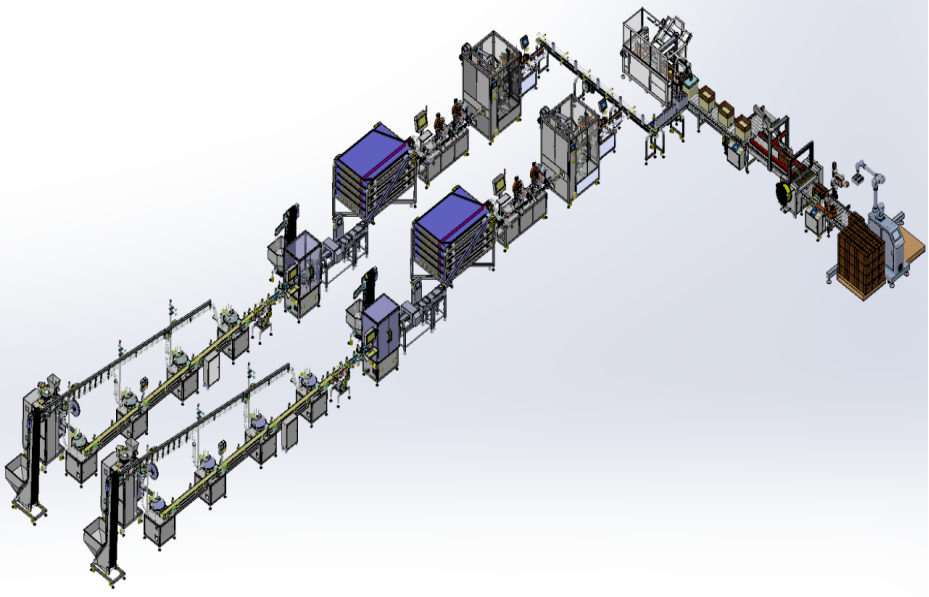
When scaling production, evaluate lane expansion, modular machine upgrades, and supplementary equipment (weighing systems, accumulators, robotic palletizing). Multi‑lane systems significantly increase throughput but require well‑designed material flow and control systems.
Packmate specializes in scalable snus and nicotine pouch solutions with multi‑lane architecture and turnkey integration—review case studies and machine options to plan capacity growth:
Case |
About Packmate.
Deployment note: plan pilot runs and OEE measurements before committing to full multi‑lane rollouts to validate line balance and product quality.
🔧 Service & Support
Long‑term support includes spare parts, remote diagnostics, and training. For specialized nicotine pouch lines, ensure your supplier provides regulatory documentation, CE/ISO certificates, and field commissioning services. For more details on after‑sales and support offerings, see:
Service.
📋 Final Checklist Before Production Ramp
– Validate recipe parameters and secure raw material lots.
– Confirm mix homogeneity and moisture targets.
– Calibrate portioning and checkweighers.
– Test seal integrity and print coding.
– Run a pilot batch and log QC metrics for at least three production cycles.
Remember: small investments in automation and inspection early on save significant cost and regulatory risk as volumes increase.
📚 Additional Resources
For equipment selection across product formats, explore Packmate’s product families including Sachet & Stick Pack machines and auxiliary systems:
Sachet & Stick Pack Machines and
Auxiliary Packaging Equipment.
📝 Conclusion
Building a reliable nicotine pouch production line requires careful integration of material handling, mixing, portioning, sealing, and inspection technologies. Emphasize in‑process controls, automation for repeatability, and vendor support for equipment tuning and compliance. With sound process design and the right machinery, manufacturers can achieve consistent product quality, high throughput, and simplified scale‑up.
Frequently Asked Questions
Q1: What are the most common packaging formats for nicotine pouches?
A1: Common formats include stick packs, sachets, round pouches, and preformed sealed pouches. Choice depends on brand positioning, shelf display, and portability requirements.
Q2: How do manufacturers control nicotine potency across batches?
A2: Through rigorous raw material testing, precise metering (gravimetric feeders), masterbatching, and routine potency assays. Automated feedback from checkweighers also reduces dosing variance.
Q3: What inspection systems are recommended for nicotine pouch lines?
A3: Checkweighers, vision systems for print and seal verification, metal detectors/X‑ray for foreign body detection, and moisture/aw sensors for stability monitoring.
Q4: Can multi‑lane systems handle different portion sizes simultaneously?
A4: Some modular multi‑lane platforms support lane‑by‑lane configuration, but most high‑speed lines require uniform portion sizes per run to maintain synchronization and accuracy.
Q5: Where can I find turnkey solutions and case studies for nicotine pouch production lines?
A5: Manufacturer websites such as Packmate provide product pages, case studies, and contact info for turnkey systems—see their product catalog and case pages for reference.